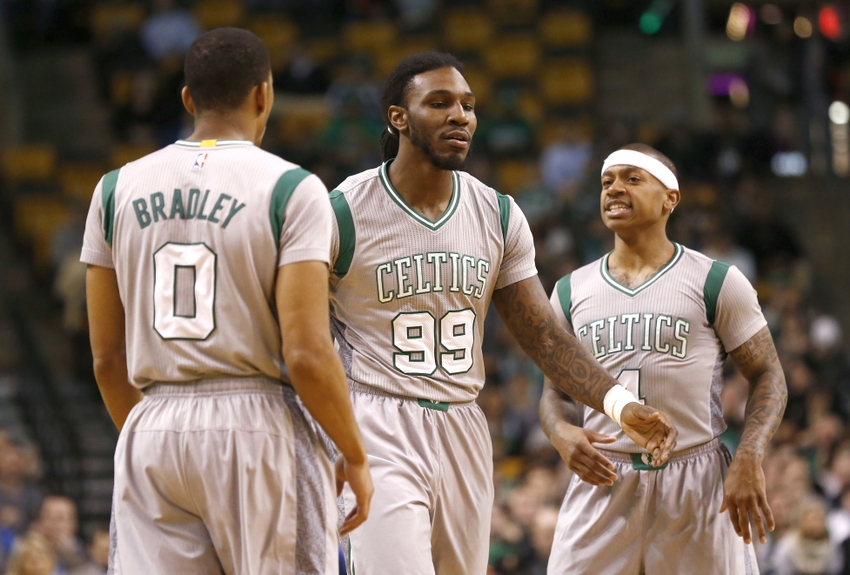
The Boston Celtics have been rebuilding for the past 4 years. Ever since the famous trade with the Nets occurred, the Celtics have kept one eye on the future, despite some significant success in the past few years. Now, the Celtics have just finished their best season since 2012, but that does not mean the rebuild is over. More draft picks will be added, free agents will be signed, and trades will be made before we can call the rebuild over. However, perhaps the most important step for a rebuild won’t be adding more players to this team. The rebuild that Danny Ainge wants to have, I believe, entails long-term success. He doesn’t want to contend for one or two years. He wants to contend for one or two decades. In order to do this, you cannot just rely on bringing in more and more talent. There is an upper limit to how much you can bring in (salary cap, luxury tax, roster limits). In order to continue improving, you need player development. The players you already have need to keep getting better in order for this rebuild to work completely. It is important to assess the steps that every player has taken (forward or backward) in order to properly evaluate the team as a whole. Have you ever finished a season in NBA 2K and you get the player development screen that everyone always skips past? Basically, it shows you how your players have improved or gotten worse at numerous aspects of the game and that is what I am hoping to do here.
Isaiah Thomas
Year
|
MP
|
FGM
|
FGA
|
FG%
|
3PM
|
3PA
|
3P%
|
eFG%
|
FTM
|
FTA
|
FT%
|
REB
|
AST
|
STL
|
BLK
|
TOV
|
PTS/G
|
2017
|
33.8
|
9
|
19.4
|
46.3%
|
3.2
|
8.5
|
37.9%
|
54.6%
|
7.8
|
8.5
|
90.9%
|
2.7
|
5.9
|
0.9
|
0.2
|
2.8
|
28.9
|
2016
|
32.2
|
7.2
|
16.9
|
42.8%
|
2
|
5.7
|
35.9%
|
48.8%
|
5.8
|
6.6
|
87.1%
|
3
|
6.2
|
1.1
|
0.1
|
2.7
|
22.2
|
The most obvious leap made this year was by Isaiah. We went
from a fringe all-star to second team All-NBA, third in the league in scoring,
and might even get a few fifth-place MVP votes. The noticeable jumps in
efficiency is what led to IT4 increasing his scoring average by over 6 points a
game. His field goal, three point, free throw, and effective field goal
percentages all increased. Adding to this jump in efficiency was Isaiah’s shot
selection. He was taking about 3 more threes per game this season compared to
last, but also shooting 2 more free throws. The Celtics have a similar offense
as the Houston Rockets, with the emphasis on threes and layups, and Isaiah
exemplifies that. Getting to the free throw line more indicates that he has
improved at getting to the paint, drawing (or exaggerating) contact, and still
getting a shot off. These are all good things. The increased reliance on Isaiah
didn’t lead to more turnovers either as he stayed right on pace with last
years’ number. This could suggest better decision making and ball handling. I
would agree that Thomas improved his ball handling, but his decision making
actually seemed a little worse this year when it came to passing. Too many
times would Isaiah leave his feet acting like he would shoot the ball, only to
turn out of the shot and pass to a teammate. Many of these did not result in
turnovers, but many were errant passes that definitely could have.
Defensively, the numbers won’t support any improvement made
by Isaiah, but I still think that his defense got a little better this year. He
is still absolutely a liability on that end, but he is always in the right
spot, knows when to go for steals, and can hold his own when bigger point
guards take him into the post. He is limited by his size, but his athleticism
and strength allows him to make at least a small difference on that end. I
would say his defense improved from an F last year to a solid D- this year.
Avery Bradley
Year
|
MP
|
FGM
|
FGA
|
FG%
|
3PM
|
3PA
|
3P%
|
eFG%
|
FTM
|
FTA
|
FT%
|
REB
|
AST
|
STL
|
BLK
|
TOV
|
PTS/G
|
2017
|
33.4
|
6.5
|
14.1
|
46.3%
|
2
|
5
|
39.0%
|
53.3%
|
1.2
|
1.7
|
73.1%
|
6.1
|
2.2
|
1.2
|
0.2
|
1.6
|
16.3
|
2016
|
33.4
|
6
|
13.4
|
44.7%
|
1.9
|
5.4
|
36.1%
|
52.0%
|
1.3
|
1.6
|
78.0%
|
2.9
|
2.1
|
1.5
|
0.3
|
1.4
|
15.2
|
Avery Bradley is another player who had significant, marked
improvement. Early in the year, the only thing that was discussed when you
would talk about the Celtics was “who can rebound for them?” Avery Bradley
decided that it was going to be him. Bradley has always been an elite defender
due to his quickness, strength, positioning, and athleticism. This year, he was
tasked with using all of that to not only play defense better than 99.9% of the
NBA, but also be one of our top rebounders. Avery is 6’2”, so he does not
exactly have the size to be an elite rebounding guard, but he was still second
on the team in rebounds. His rebounding grade went from a C last year to a B+
this one.
Another area that Bradley clearly worked on improving was
his shot creation. He took about 5 shots a game after having the ball for more
than 2 seconds this season, compared to 4 of these shots last season. He also
took almost 7 shots a game after using one or more dribbles, compared to 6 last
season. Now, depending on your view of the offense of this team, this could be
a good or a bad thing. Personally, I view it as a good thing because this team
needs a secondary playmaker/shot-creator. Some of the percentages that Avery
shot on shots like these were down however, so if he is forcing shots, it is
certainly not good. He took similar numbers of open and closely guarded shots
this year and last year, so I don’t think much has changed in his shot
selection. I did notice improvement in Avery’s ability to create open shots for
himself had improved. His handle looked a little tighter and he seemed more
comfortable dribbling this year.
Jae Crowder
Year
|
MP
|
FGM
|
FGA
|
FG%
|
3PM
|
3PA
|
3P%
|
eFG%
|
FTM
|
FTA
|
FT%
|
REB
|
AST
|
STL
|
BLK
|
TOV
|
PTS/G
|
2017
|
32.4
|
4.6
|
10
|
46.3%
|
2.2
|
5.5
|
39.8%
|
57.2%
|
2.4
|
3
|
81.1%
|
5.8
|
2.2
|
1
|
0.3
|
1.1
|
13.9
|
2016
|
31.6
|
4.9
|
11.1
|
44.3%
|
1.7
|
5
|
33.6%
|
51.8%
|
2.7
|
3.3
|
82.0%
|
5.1
|
1.8
|
1.7
|
0.5
|
1.1
|
14.2
|
Despite a perhaps lackluster playoffs, Jae is the third
starter in a row to have increased efficiency this regular season. Most
noticeable is his three-point percentage which went from below league average
in 2016, to almost elite territory. That is one heck of a jump in one season
(Marcus Smart it’s your turn now please). Jae actually took less shots this
season than he did last season, and I think that might have been what
ultimately helped his efficiency. With the added spacing provided by Al Horford
as well as the offensive load that he took over, Jae wasn’t relied upon as much
to score. This let him be more selective with his shots, leading to his higher
percentage. Like Avery’s rebounding, Jae’s three-point shooting grade went from
a C to a B+ this year. If Jae can continue shooting like that, he and his
contract will be an incredibly valuable asset.
Defensively, Jae was a mixed bag this year. By traditional
measures, his steals and his blocks were down, which could mark a decrease in
his involvement or intensity on that side of the ball. Opponent’s field goal
percentage tell a different story however. Players shot 3.6% worse when guarded
by Jae Crowder than they did for the year. Compared to last year, he improved
his opponent’s field goal percentage from every distance except from inside of
ten feet, where opponents shot 7.6% better than their season average compared
to only 4.7% better last year. Jae’s defensive rating of 104.5 was his worst
mark of his Boston career, but he did post his highest net rating of his Boston
career with a 7.8.
Overall, I think Jae’s improvements on offense outweighed
any decrease in his defensive performance, but it would be nice to get the best
of both worlds. A Jae Crowder with the three-point shooting from this year
combined with the tenacious defender of prior years would be a scary, scary
thing.
Al Horford
Year
|
MP
|
FGM
|
FGA
|
FG%
|
3PM
|
3PA
|
3P%
|
eFG%
|
FTM
|
FTA
|
FT%
|
REB
|
AST
|
STL
|
BLK
|
TOV
|
PTS/G
|
2017
|
32.3
|
5.6
|
11.8
|
47.3%
|
1.3
|
3.6
|
35.5%
|
52.7%
|
1.6
|
2
|
80.0%
|
6.8
|
5
|
0.8
|
1.3
|
1.7
|
14
|
2016
|
32.1
|
6.5
|
12.8
|
50.5%
|
1.1
|
3.1
|
34.4%
|
54.7%
|
1.3
|
1.6
|
79.8
|
7.3
|
3.2
|
0.8
|
1.5
|
1.3
|
15.2
|
It’s not entirely fair to compare Horford’s season this year
with his prior ones due to this being his first season with the Celtics, but it
is still valuable to see what he is doing better or worse here compared to his
time in Atlanta. The biggest shift in Horford’s numbers come in the assists
department. He averaged a career high 5 assists per game in his first season in
Brad Steven’s system, compared to his previous high mark of 3.5. That is quite
a jump. The addition of Al Horford is probably the single biggest factor when
it came to the development of other Celtics players. Having a big guy who is a
threat to score from anywhere in the half-court and being perhaps the best
passing center in the league led to a lot more open shots for everyone else. I
believe that most of the players on the Celtics roster improved with regards to
their own skill this season, but the improvement statistically for this team is
due in large part to Al Horford.
Horford had his lowest scoring season since 2012, averaging
only 14 points per game this year. This was by design however. Brad clearly
wanted Horford to be more of a facilitator on offense rather than a scorer.
Horford only took 11.8 shots per game. I would expect this to be fairly
consistent for Al’s time in Boston. We should be bringing in more and more
scorers over the next couple of years with (hopefully) Markelle Fultz and
possibly Gordon Hayward. This will truly allow Horford to flourish passing
wise.
The biggest and most obvious disappointment with Horford
this season was his rebounding. He had his lowest rebounding average of his
career this season, which was a big reason why the Celtics were such a dreadful
rebounding team. However, this lack of rebounds makes sense in the system. In
Horford’s prime rebounding days, he was averaging between 2.5 and 3 offensive
rebounds a game, compared to his 1.4 per game this year. With his shift to a
more perimeter orientated role, he spends more time on the three-point looking
for a shot or finding cutting teammates. This one-to-two rebound a game
difference goes a long way in his rebounding number from falling from around 9
a game to about 7 now.
Amir Johnson
Year
|
MP
|
FGM
|
FGA
|
FG%
|
3PM
|
3PA
|
3P%
|
eFG%
|
FTM
|
FTA
|
FT%
|
REB
|
AST
|
STL
|
BLK
|
TOV
|
PTS/G
|
2017
|
20.1
|
2.7
|
4.6
|
57.6%
|
0.3
|
0.8
|
40.9%
|
61.2%
|
0.8
|
1.3
|
67.0%
|
4.6
|
1.8
|
0.7
|
0.8
|
1
|
6.5
|
2016
|
22.8
|
3.2
|
5.4
|
58.5%
|
0.1
|
0.5
|
23.3%
|
59.6%
|
0.9
|
1.5
|
57.0%
|
6.4
|
1.7
|
0.7
|
1.1
|
1.2
|
7.3
|
A starter in name only, Johnson barely cracked 20 minutes
per game this year and it was clear that Brad was preparing for his role to be
reduced or gone next season. Johnson was supposed to bring defense and
rebounding to a team that sorely needed it. He brought the defense. Inside of
10 feet, Johnson held opponents to shooting 8.2% below their season averages
and 10.7% below inside 6 feet, both stellar marks. He had a defensive rating of
103.4 this season which is a solid number. This allowed him to have a net
rating of 8 on the year. The rebounding fell off a cliff for Amir this season
however. 4.6 per game is his lowest average since he played in Detroit in 2009,
and he was only getting 14.7 minutes per game then. What really hurt this
number was his offensive rebounding rate, similarly to Al Horford. Johnson
grabbed only 8.4% of available offensive rebounds, the lowest percentage of his
career. This has similar reasoning to Horford’s case. In Brad Stevens’ offense,
there is no room for a big guy to be parked in the paint waiting for rebounds.
Oftentimes, Amir was on the perimeter giving Isaiah and Horford room to
operate. It is hard to get rebounds from the three-point line.
Johnson’s 30 years old and just finished his 12th
season. His time in the league is catching up to him and he is beginning a
downward trend statistically. He will probably play less next season, as the Celtics
will have Ante Zizic coming over from Europe who should be able to play a
similar role as early as next season. Johnson has been slowly adding a reliable
three-pointer to his arsenal, shooting a career best 40.9% on almost one
attempt per game. I would expect Amir to continue working on that so that he
could still play a role as a stretch four in the modern NBA. He will have a lot
of work to do though as every three he took was either open or wide open
according to NBA tracking stats. His release his incredibly slow so I am not
sure if he will ever be a reliable shooter.
Johnson still had a valuable role on this season’s team as
the starting center, but I think the Celtics will be looking to get younger
upfront and this will lead to his role being reduced further, if he is back on
the team at all next season.
The Celtics took a big step forward this season. Our rebuild
has gone quicker than anyone would have expected, but that does not mean it is
over. We have improved every year since trading away Paul Pierce and Kevin Garnett,
thanks to some great player additions, but also thanks to our players getting a
lot better. In order to ultimately win a championship, the Celtics will need to
add more talent, but they also need to continue developing the players they
have, like they did this year.

No comments:
Post a Comment